The Price Is Not the Probability
By Alan Wu • Published June 5, 2026 • Originally posted on X
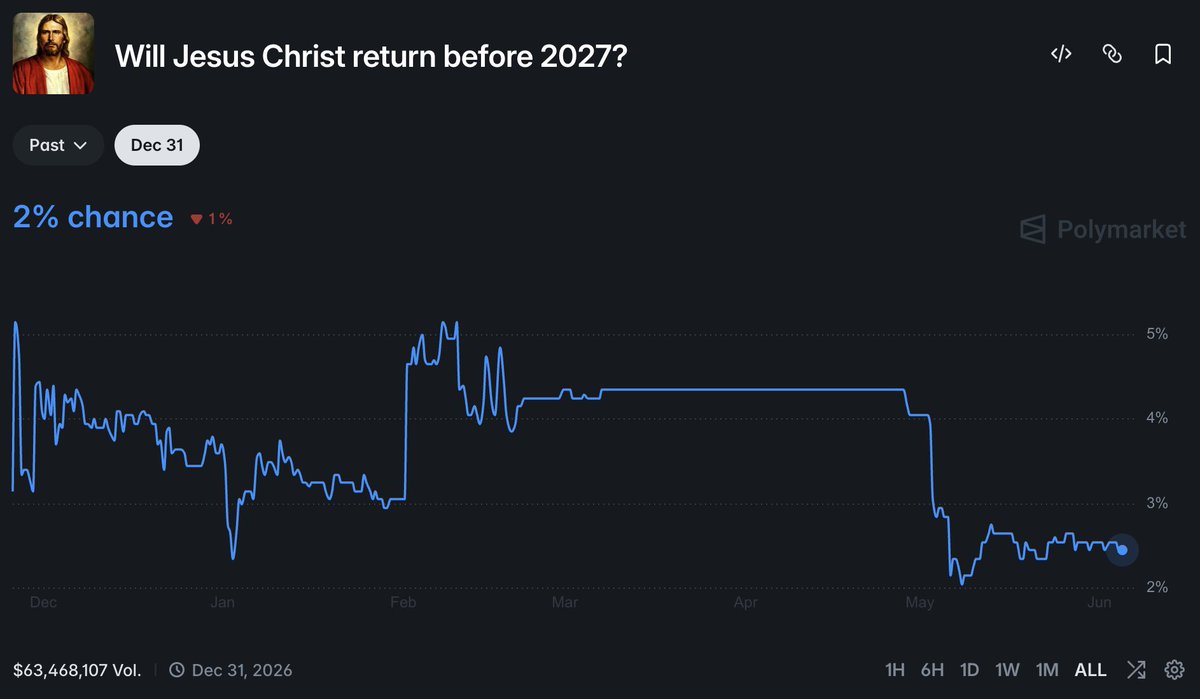
Polymarket gives Jesus a 2% chance of returning in the next 6 months.
It’s obviously a meme, but the money is real. Liquidity sits around 2.0 - 2.1¢ and people are actively trading it.
The question is: if everyone knows that’s not the probability, why is that the price?
The answer applies to every prediction market, including the serious ones.
The price is not the probability because the instrument is not the event.
A prediction market price is the clearing price of a contract about an event. That contract lives inside a machine: rules, collateral, fees, resolution risk, hedging demand, liquidity incentives, correlated books, and market structure.
The event becomes a contract
You’re not trading the event. You're trading a contract with rules, sources, edge cases, and a resolver.
"Will Zelenskyy wear a suit?"
Well, the news said he did at NATO. But the market still resolved to No.
The market wasn't pricing Zelenskyy. It was pricing how UMA would rule on him.
Every market makes this translation:
event → rule → resolver → payout
The price absorbs the distortion at each step.
What is "a consensus"? Which sources are credible? What about edge cases? By the time you trade it, the contract isn't quite the event anymore.
The "same" market on two platforms isn't the same contract. The 2026 Super Bowl Cardi B halftime market: Polymarket resolved YES, Kalshi settled at the last traded price. This alone also makes cross-platform aggregation fragile.
On Polymarket's $400 million "MicroStrategy sells any Bitcoin by May 31, 2026?" market: MicroStrategy sold BTC in the window. The market resolved to No.
The contract has payoff economics
A perfectly-specified contract still absorbs the economics of the collateral asset.
Time value. Capital locked in a market could have earned yield elsewhere. So the price has to reflect the cost of tying that capital up, not just the probability of the event. Yield-bearing collateral can recover some of this opportunity cost: Trueo and Kalshi do this across their markets; Polymarket does it on some markets.
There is also a more endogenous form of time value: the value of liquid cash can rise before resolution. If better opportunities appear, holders of an almost-certain, low-upside position may pay a premium to exit, giving the other side resale value even when the event probability hasn’t changed.
State-contingent payout. When the event impairs the collateral itself, the YES payout must be discounted by what the collateral is actually worth in that state of the world. The cleanest case is a USDC-denominated market on whether USDC depegs: if YES resolves, the $1 payout isn't $1. This shows up anywhere collateral and event move together. @danrobinson discusses this here:
Flow includes motives other than belief
The price clears belief, hedging, entertainment, speculation, manipulation, and subsidy farming with no labels attached.
Non-informational demand. Some trades aren’t forecasts at all. Someone buys $5 for fun. A Cowboys fan just bets the Cowboys. Someone buys just because they think the next buyer will pay more.
Hedging. Some demand is risk transfer, not forecast. Someone can take a position just as a hedge. The price absorbs that demand even if the probability of the event has not changed.
This is another valuable use case of prediction markets. I work through this here:

Liquidity incentives. Platforms pay market makers to quote tight spreads. That improves liquidity, but it also creates gravity around whatever prices the reward function favors.
This liquidity is optimizing for the incentive, not forecasting the event. It still affects the price.
Manipulation and adverse selection. Once a market matters enough for reflexivity to take off, manipulation becomes a real motive. For instance, a politician’s campaign has an incentive to inflate their own market or deflate an opponent’s. I work through the tradeoffs of manipulation and friction of money here:
The hard part is that this flow does not announce itself. A price move may be from any of these reasons. Or it could be from real information. So it’s hard to just move the price back. The trader fading the move is also taking the risk that they are fading information.
Markets are connected
Correlated markets also transmit distortions, not just information.
Correlated rebalancing. Sophisticated traders in the presidential race also hold the popular vote market, the swing state markets, and the Senate market as one correlated book. When one moves, they rebalance across the others. Most of the time this is information transmission: a swing state moves on real news, and the presidential repositions accordingly.
Contagion of distortions. Correlated markets transmit more than information. They can also transmit wedges.
A hurricane market pushed up by hedging demand is pricing P(hurricane) plus a hedging premium. If a city-economy market is correlated with that hurricane market, rebalancing can pass the premium along even if nothing about the city has changed.
The distortion now looks like information.
This can compound when the same counterparties absorb many correlated hedges, concentrating their books. They charge for that portfolio risk, and the premium propagates through every correlated market they quote.
Conditional markets are one structural response: price P(X|Y) directly, instead of burying the dependency inside correlated rebalancing.
Markets correct prices; they do not average minds
"Wisdom of the crowds" is an intuitive story, but it confuses aggregation with correction.
A market is not a poll. Most people have no view. Many who do never trade. And even when they do, the trade may not be a forecast. It may be a hedge, a joke, a subsidy farm, a speculation, or manipulation.
The mechanism is closer to adversarial error correction.
The crowd is not wise. The market structure just makes some errors expensive and some corrections profitable.
But correction has to be worth it.
Every trade has costs: fees, spread, slippage, capital lockup, attention, and resolution risk. These create a no-trade band around the displayed price. A market can be wrong and still not be wrong enough to fix.
This is especially true in tail markets, where small absolute fees become large percentages of capital. On Polymarket and Kalshi, a 1¢ YES can pay roughly 100x more in realized fee rate than a 99¢ YES.
The market reveals where the marginal correction stops being worth it.
And a good market is one where error is easy to correct.
CLOBs don’t average beliefs
Even if you stripped away the obvious frictions — fees, spreads, collateral risk, resolver ambiguity, hedging demand, manipulation — the displayed price still wouldn't become the crowd’s average probability.
A CLOB is not a belief-averaging machine. It is a trade-clearing machine. It takes orders, quantities, bankroll constraints, risk limits, and the shape of the book as inputs, then produces the price where marginal supply meets marginal demand.
@quantian1 walks through this idea here:
The price can be probability-like and useful as a best available number. But it is not computed by averaging minds.
The number isn't the thing
The displayed price distills a much richer state. People fixate on it and call it the probability.
Interfaces should surface the story beneath the price, like equity terminals do, and also add features only this asset class allows: rule diffing, resolver track records, on-chain flow attribution, implied conditionals across markets, subsidy overlays, etc.
Closing
The price is not the probability because the instrument is not the event and the number is not the thing.
Jesus is trading at 2.1%, but unfortunately the chance he’s coming back this year is 0.
Thank you to @distbit0, @ryanchern, @The_Zhukeeper for thinking through this with me!